IPLT review
Introduction to Professional Level Trading
The quantitative foundation: how to measure realised, implied and portfolio-level volatility, so you can put a number on risk before you trade.
ITPM's introductory course and the natural place to begin if you want the foundations in place before moving into the broader PTM framework.
Standard price $1,299 discounted price $649.50 with code ipltrich50pct, save 50%
12-month course access
- Format
- Online video · 12-month access
- Prerequisites
- None. It is the entry point, and basic Excel comfort makes a big difference.
- Tools unlocked
- Core Workbench
Affiliate notice: I may earn a commission from marked enrolment links. You pay no extra.
The enrolment link above carries the code for you, or you can enter it at checkout.
New to ITPM? Start with what ITPM is, or see how the four courses compare on price and value.
Reviewed by
Richard Sarsfield
Richard spent more than 25 years in institutional asset management. He took the ITPM courses himself and reviews them on their merits. He is not an ITPM employee, mentor or spokesperson.
- Last updated
- 6 September 2026
- Course facts last verified
- 17 August 2026
Why IPLT is a sensible first course
The IPLT is a more focused course than its title suggests: a quantitative introduction to measuring volatility at three levels, realised, implied and portfolio. It is built around Excel classes where you construct the measurement tools yourself, and in my view that hands-on spreadsheet work is the course's real strength. Most beginner content describes risk. This course has you measure it, across equities, bonds, indices and currencies.
IPLT concentrates on volatility, statistics and position sizing. That focus is its strength: it gives a new trader a numerical grounding before money is put at risk. The spreadsheet classes are where the material becomes something you can use, and you keep the calculators you build. For the broader macro and stock-selection process, PTM is the natural next step.
The quantitative work inside it
At $1,299 you get Online video · 12-month access, roughly 18 hours of video across ten modules. The syllabus:
- How professional and institutional traders differ from retail traders in mindset, process and attitude to risk
- A statistics primer for asset returns: distributions, standard deviation, skewness, kurtosis, correlation and covariance
- Realised volatility two ways, by distribution of returns and by Average True Range percentage, across equities, bonds, indices and currencies
- Implied volatility and the VIX, including why retail volatility products usually fail as hedges
- Portfolio volatility: how correlation means portfolio risk is not simply the sum of the positions
- Excel build-along classes where you construct the volatility calculators yourself, and keep them
The spreadsheet exercises I would not skip
Building the calculations in Excel helps turn risk from an abstract warning into something you can measure. That hands-on element is the course's main strength.
- Hands-on: you build the measurement spreadsheets yourself instead of just watching
- Puts a number on risk: the volatility grounding most beginner courses skip entirely
- The VIX-products case study is a structurally grounded warning that can save a beginner real money
Start here if the numbers are new to you
Choose IPLT if you want a clear grounding in volatility, position sizing and portfolio risk before moving into broader macro and security-selection work. It suits complete beginners, self-taught traders who have never measured the volatility of what they hold, and finance students who want the practical version. Its subject is measurement rather than macro strategy or stock selection; that is the PTM.
Where IPLT fits in ITPM's sequence
A spreadsheet-led introduction to volatility and risk. You do not need advanced Excel, but willingness to work through the calculations will help. If macro and stock selection are your main objective, PTM is the natural next step.
Expect to use Excel. Building the calculators yourself is part of the learning
The Position Sizer and the Pair & Hedge Calculator do the same risk and volatility arithmetic as web tools, so a broken formula never stalls your progress through the material. They don't replace building the calculators yourself. That is the point of the course. They do mean you can follow every concept while your own spreadsheets are still rough.
A focused volatility-and-statistics course, by design
That focus is the course's strength. Measuring volatility properly is the grounding every later ITPM course assumes you already have, and almost no beginner material teaches it. My review sets out the real syllabus before you pay, and in my view it's the right first purchase precisely because it is focused.
If you enrol through this site
What you get with the IPLT
Core Workbench
Enrol in the IPLT through a link on this site and I'll add 12 months' access to the Workbench once ITPM verifies the referral: practical planning, sizing and review tools for your own trades. Enrolling in ITPM elsewhere doesn't qualify.
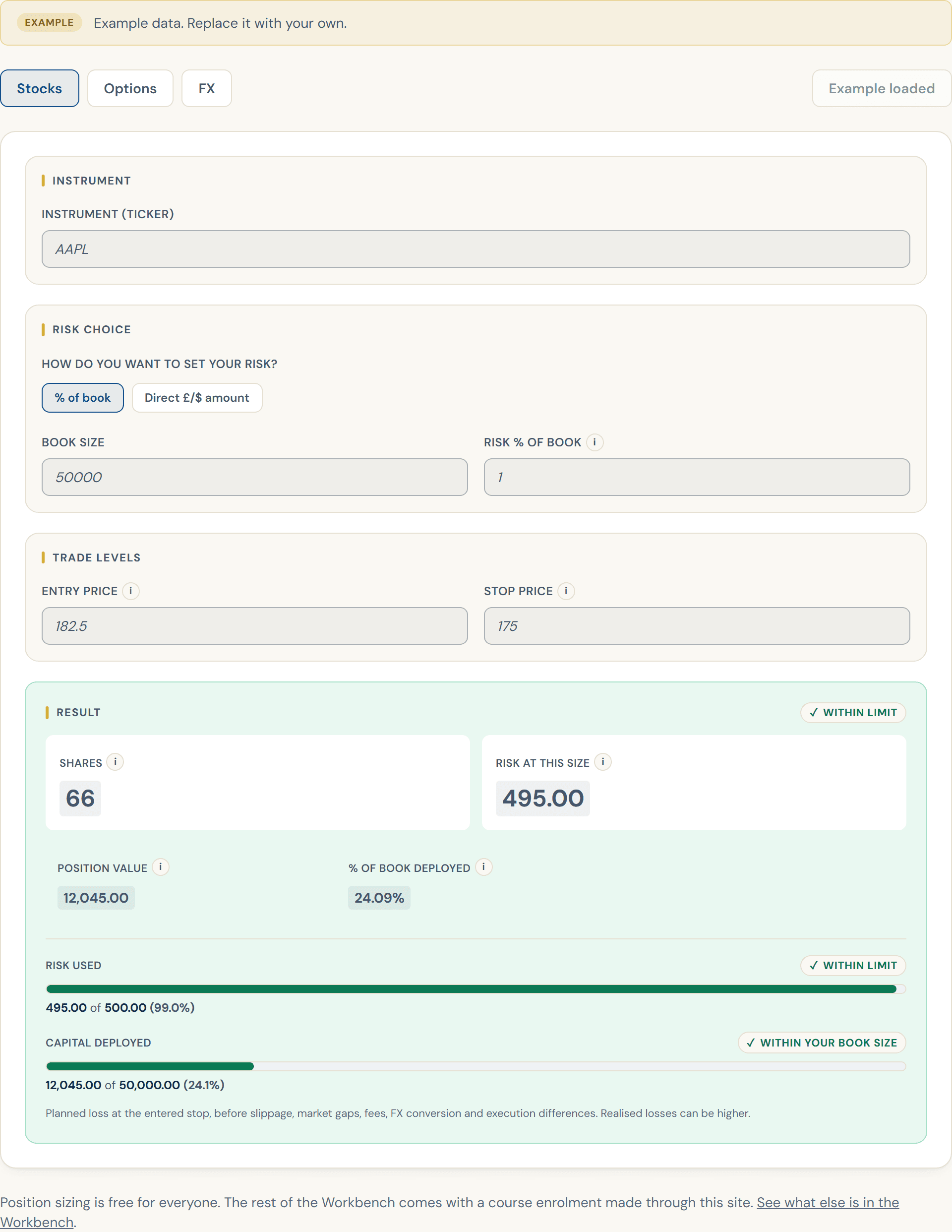
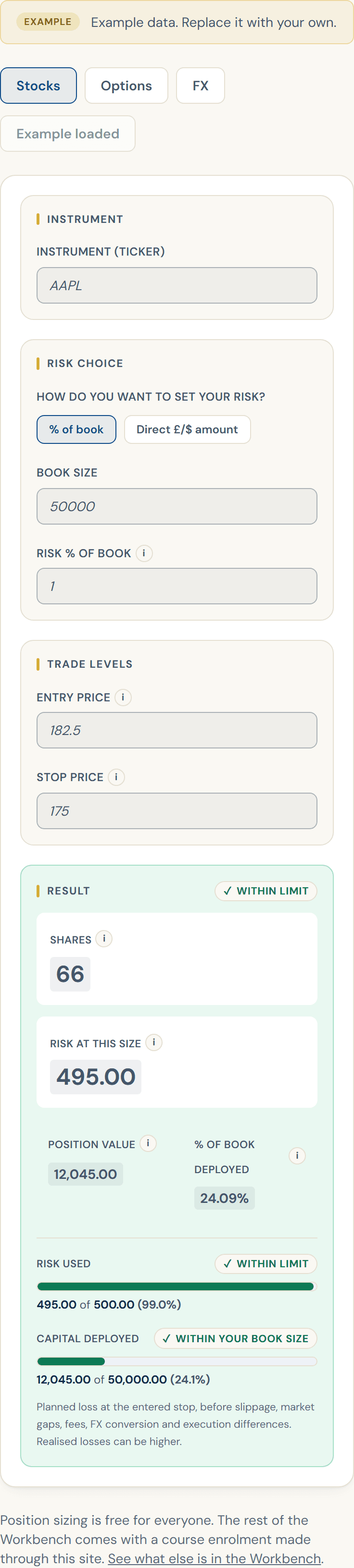
Position Sizer. Example data.
Core Workbench
Comes with any ITPM course, including IPLT.
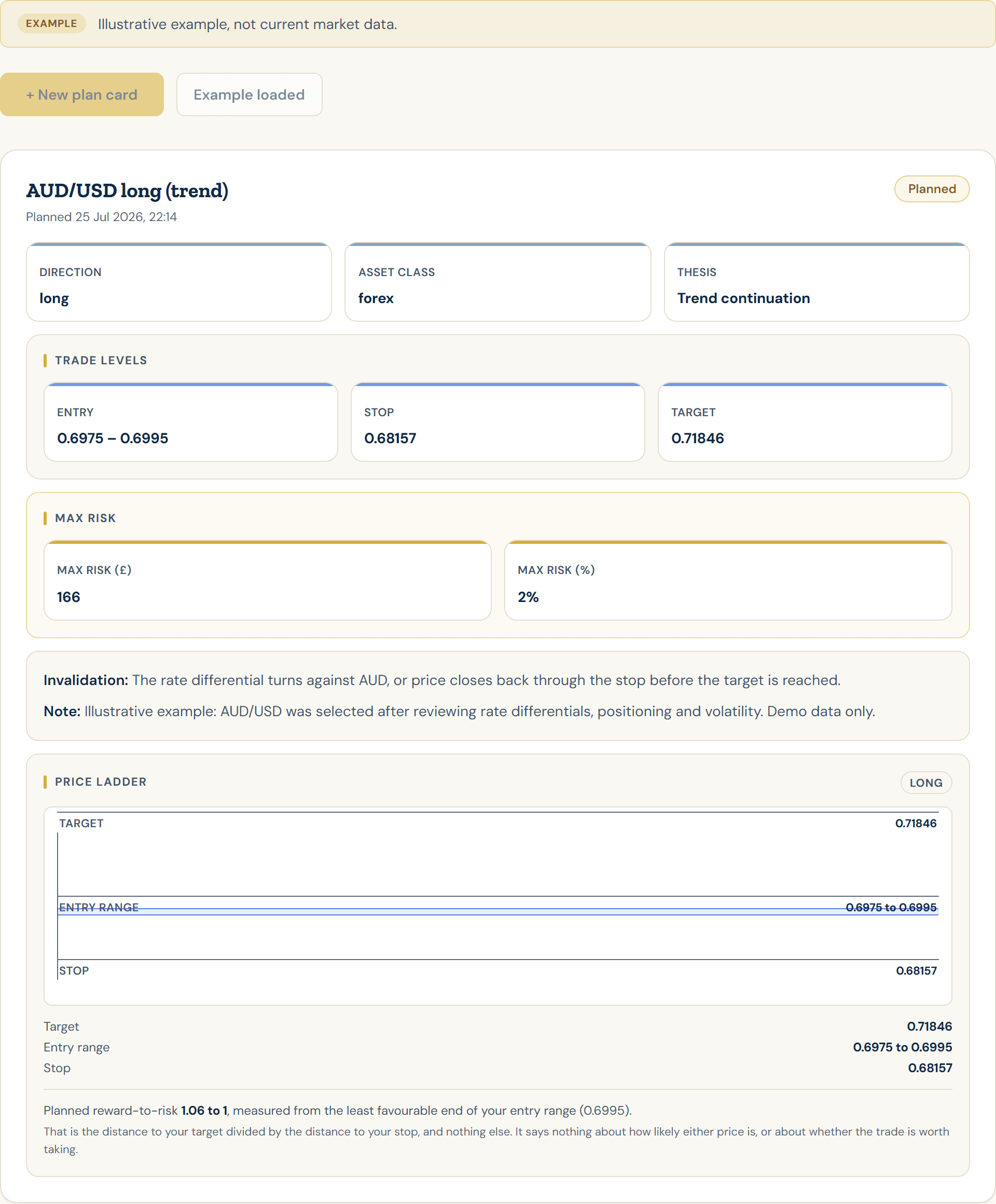
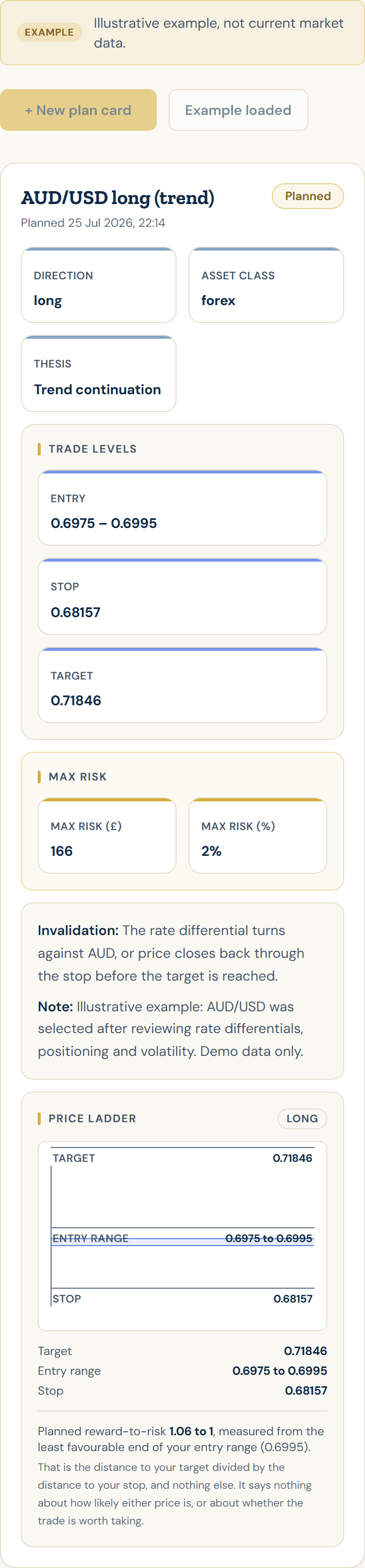
- Trade Plan Card
- Position Sizer: free for everyone
- Trade Journal
- Plan Adherence Review
IPLT: Core Workbench only
The IPLT is the foundation course, so it unlocks the Core Workbench and nothing more. It has no course-specific tool pack. Those come with the PTM, POTM and PFTM. The free Macro Dashboard (email signup) covers the market context either way.
No extra charge and no separate checkout.
Current IPLT offer
Standard price $1,299 discounted price $649.50 with code ipltrich50pct, save 50%
12-month course access
You pay ITPM directly.
Ask Richard which course fits
Course questions come directly to me. Tell me what you already trade and what you want out of the IPLT, and I'll tell you whether it's the right one for you or whether another course is a better fit.
Prices, discounts and course terms are set by ITPM and may change at any time. Last checked 17 August 2026. Please verify the final price and terms at ITPM checkout.