ITPM explained
What is ITPM?
ITPM is a trading-education business founded by Anton Kreil. Its courses focus on macro analysis, portfolio construction, security selection and risk management from an institutional perspective.
The four online courses serve different purposes. PTM is the flagship programme. IPLT covers the risk and volatility foundation. POTM specialises in options, and PFTM specialises in currencies.
Why I value it
What appealed to me was the connection between the economic view and the portfolio decision. The courses do not stop at finding an idea. They also cover position size, portfolio fit and risk.
That is the part closest to my own experience in institutional asset management. If you want a firm grounding in volatility and risk, IPLT is the natural place to begin. PTM is the core programme when you are ready for the wider macro and portfolio framework.
The top-down process ITPM teaches
ITPM teaches a four-step process. Each stage narrows the focus, from the global economy down to a single position held inside a portfolio.
- Macro environment. The business-cycle stage, what central banks are doing, and what the yield curve is signalling.
- Sector rotation. Which sectors tend to do well in that macro regime, and where the tailwinds and headwinds sit.
- Stock selection. Within those sectors, which companies offer the better risk and reward.
- Portfolio construction. How to combine long and short positions for a risk-adjusted return.
Long/short portfolio management
Long/short portfolio management is one of the central ideas. A portfolio holds both long positions, which benefit if prices rise, and short positions, which benefit if prices fall.
ITPM says the aim is to reduce exposure to the market's overall direction and to frame each idea in relative terms, one holding against another. That is also how the institutional books I worked with were put together, which is part of why the material felt familiar to me.
Who ITPM is aimed at
ITPM markets its courses at a broad audience, including:
- Traders who want to learn an institutional-style method
- Finance students preparing for careers in asset management
- Experienced investors adding a top-down macro process
- Anyone who wants position sizing and portfolio risk taught properly
The ITPM pathway
The ITPM course sequence
ITPM's recommended order is IPLT, then PTM, then POTM and PFTM, with PFTM often taken six to twelve months after PTM. PTM is the flagship, and it is the course ITPM requires for Institute Trader status. POTM and PFTM can be taken on their own, and they work best once the PTM foundation is in place. ITPM sets the sequence out in its course FAQ.
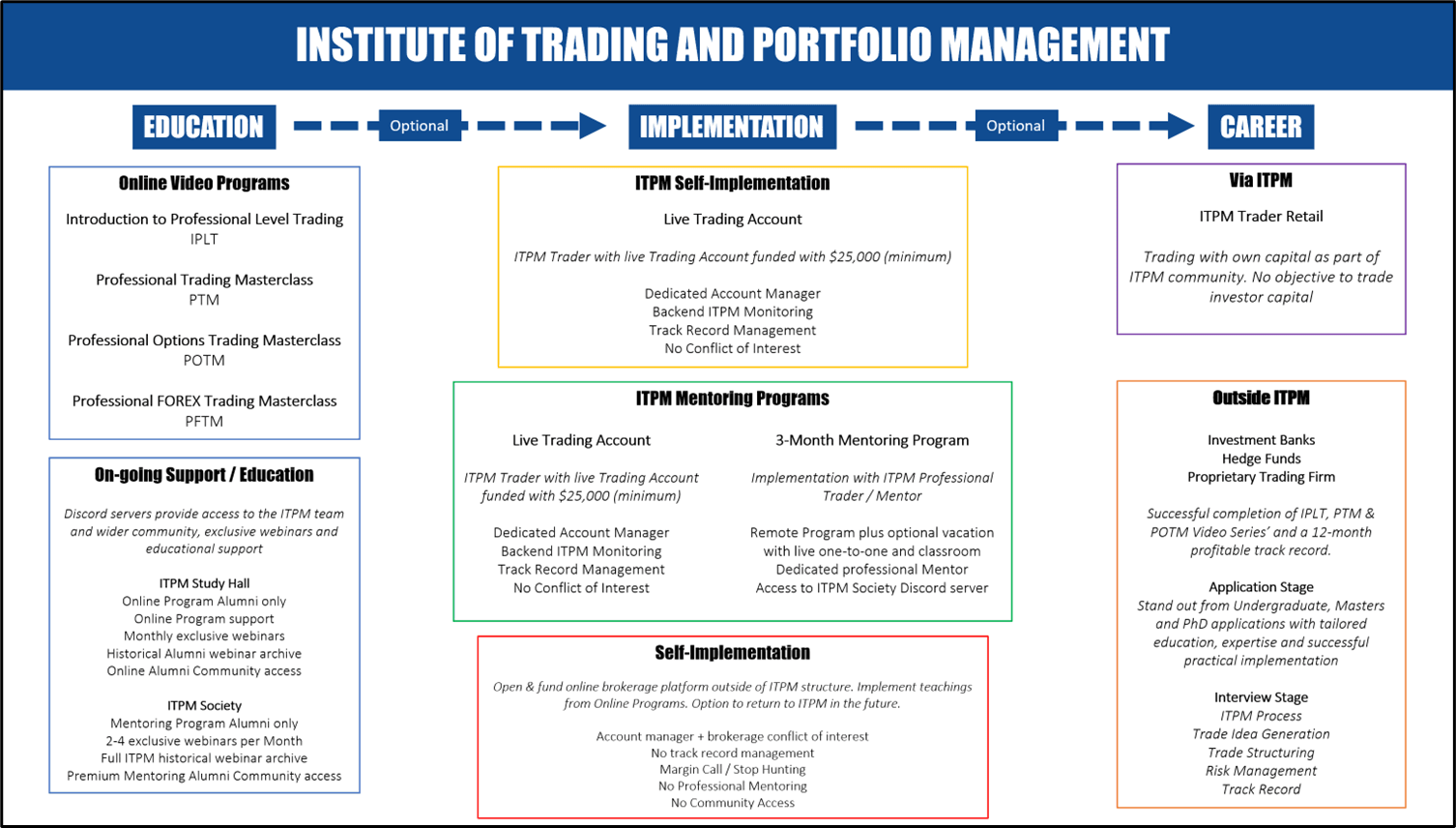
ITPM's own progression diagram, reproduced with permission.
- 1Read the IPLT review →
IPLT: Introduction to Professional Level Trading
The quantitative foundation: how to measure realised, implied and portfolio-level volatility, so you can put a number on risk before you trade.
Online video · 12-month access
- 2Read the PTM review →
PTM: Professional Trading Masterclass
The flagship course. The full macro-first approach and long/short portfolio methodology in one place.
43 videos · ~64 hours · 12-month access
- 3Read the POTM review →
POTM: Professional Options Trading Masterclass
Professional options trading: pricing, the Greeks and defined-risk structures for expressing a macro view.
Online video · 12-month access
- 4Read the PFTM review →
PFTM: Professional Forex Trading Masterclass
Macro-driven currency trading, led by fundamental analysis at a professional level.
29 videos · 12-month access
Format and access as listed by ITPM on each course page. Confirm the current details at itpm.com.
Choosing between them
I have written a review of each course. They set out the modules, what the course assumes you already know, and the reader I think it suits.